

By Enrique Gomez | Maple & Stone Cabinetry N More, Inc. | Woodland, California
The short answer: No flooring, cabinet or countertop can make a room flood-proof. A product may handle everyday spills or qualify as flood-damage-resistant for a defined use, yet the full assembly can still fail when water reaches seams, adhesives, underlayment, subfloor, wall cavities or cabinet supports. Start by verifying the property's current flood information and the room's likely water exposures. Then compare the complete system, installation instructions and warranty - not a single marketing word on the sample. After significant water intrusion, safety, contamination and rapid professional drying take priority over deciding which finish can be saved.
Why Does Moisture-Conscious Planning Matter in Woodland?
The City of Woodland's flood-zone information states that major portions of northern and eastern Woodland are within a FEMA-designated Special Flood Hazard Area and that significant construction in those areas may face restrictions. Yolo County also provides flood-zone determination resources and map links.
A mapped flood area is only one reason to think about moisture. Dishwashers, refrigerators, washing machines, sinks, toilets, water heaters, slab moisture, crawlspaces and roof or window leaks can expose interior materials to water. The right planning question is not simply, "Is this floor waterproof?" It is, "What kind of water exposure is plausible here, and how will the entire assembly respond?"
What Do Waterproof, Water-Resistant and Flood-Damage-Resistant Mean?
Water-resistant and waterproof are commonly used product terms, but their meaning depends on the manufacturer's test method, installation instructions and warranty. A waterproof plank may resist water passing through its core while moisture still reaches the perimeter, joints, underlayment or subfloor. A water-resistant cabinet finish may tolerate wiping and ordinary splashes without being intended for standing water.
FEMA Technical Bulletin 2 uses the more specific concept of flood-damage-resistant materials for construction below the required flood elevation. FEMA defines performance in relation to direct and prolonged floodwater contact without significant damage, but the bulletin addresses building-code and floodplain applications - not a promise that a finished kitchen will be unaffected by a flood.
The terminology should therefore lead to questions, not conclusions. Ask what part of the product is protected, how long exposure is covered, whether seams or perimeter conditions are included, which installation system is required and what exclusions appear in the warranty.
Why Is the Visible Flooring Only One Part of the Decision?
A floor is an assembly. The finish sits over an adhesive, locking system or mortar bed; possibly an underlayment or membrane; and a concrete slab or wood subfloor. Water can travel below a finish that appears intact, and the lower layers may dry at a different rate. Trapped moisture can also affect walls, baseboards and cabinets.
Substrate flatness and moisture conditions must be within the flooring manufacturer's limits before installation. After a leak, the surface may look dry while the underlayment or subfloor remains wet. Moisture testing and a qualified assessment are more reliable than appearance or touch alone.
How Should Common Interior Materials Be Evaluated?
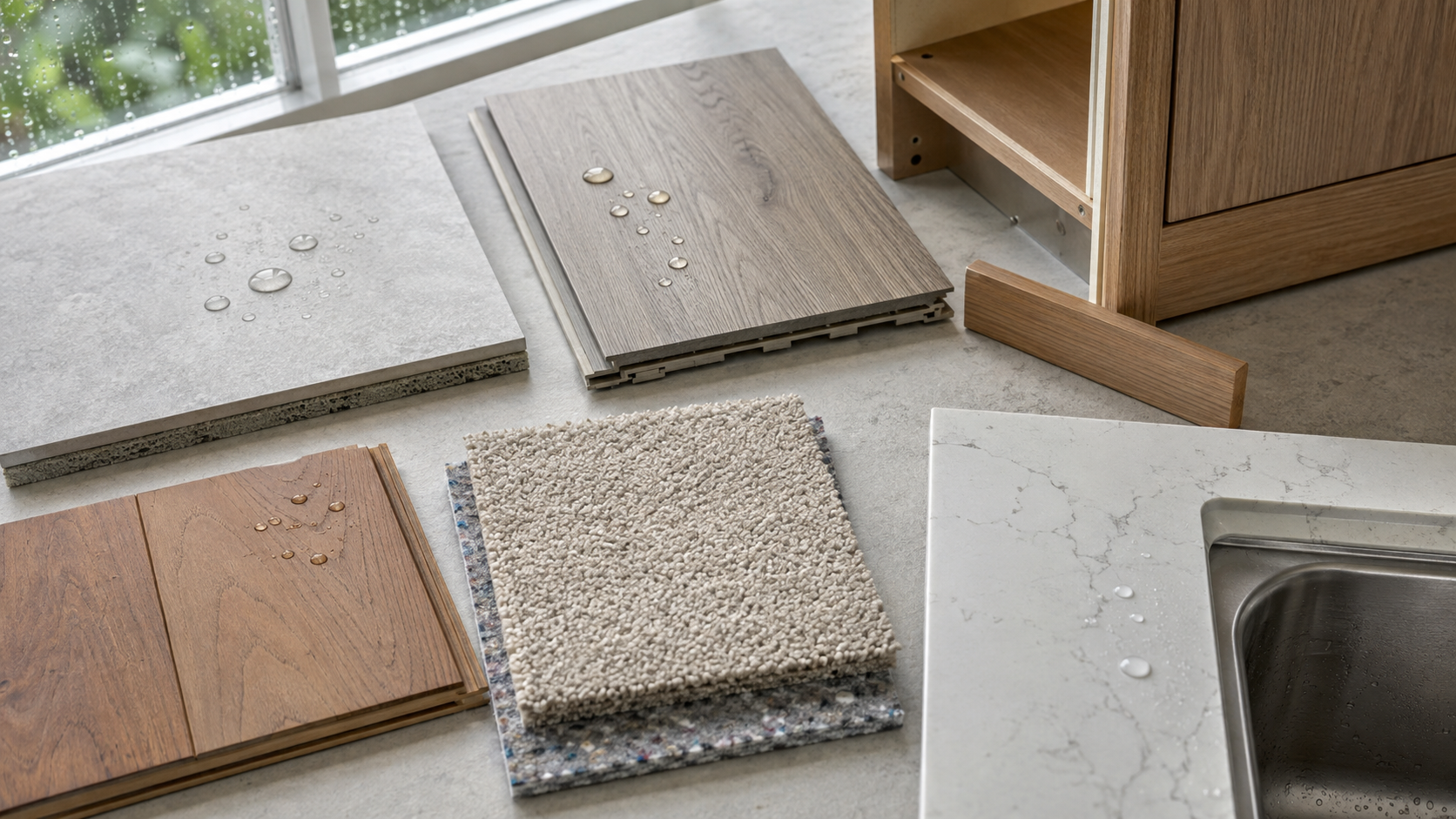
| Material or system | Potential advantage | What must be verified |
|---|---|---|
| Ceramic or porcelain tile | The tile surface itself can tolerate routine water exposure and cleaning. | Grout, perimeter joints, setting materials, membrane, substrate and movement details; tile does not make the assembly flood-proof. |
| Luxury vinyl tile or plank | Many products are marketed for spill-prone spaces and can be easy to clean. | Exact waterproof claim, locking or glue-down method, perimeter details, underlayment, substrate moisture limits and warranty exclusions. |
| Solid or engineered wood | Can provide continuity and may be repairable or refinishable depending on the product. | Species or product construction, finish, humidity range, substrate, installation method and response to prolonged moisture. |
| Carpet and pad | Comfort, warmth and sound absorption. | Drying and replacement requirements after water exposure; padding and subfloor must be evaluated, not just the face fiber. |
| Cabinet boxes and toe kicks | Some finishes handle ordinary kitchen or bath splashes well. | Box and back materials, finished edges, toe-kick construction, wall or subfloor contact, plumbing access and manufacturer warranty. |
| Countertops | Many surfaces tolerate routine cleaning and short-term spills. | Porosity, sealing, seams, edge details, sink cutouts and the condition of the cabinet or substrate supporting the top. |
This is a decision framework, not a performance rating. Product-specific documentation and field conditions control.
Is Tile Always the Best Choice for a Flood-Risk Area?
Tile can be a strong option because the surface is durable and does not behave like an absorbent textile. But tile is not an automatic answer. The grout, mortar, membrane, subfloor and perimeter conditions remain part of the system. Water can also migrate into adjacent walls or cabinets while the tile itself appears unchanged.
A hard tile floor may be less comfortable underfoot, can be difficult to remove and may crack when substrate movement is not properly addressed. Choose it because the full system suits the room and project - not because the word "tile" is treated as a guarantee.
Can Waterproof Vinyl Flooring Survive a Flood?
Do not equate a waterproof product claim with flood recovery. The plank or tile core may resist water while moisture reaches the underlayment, adhesive, slab, wood subfloor or wall edges. Contaminated floodwater creates sanitation concerns that are different from an ordinary clean-water spill.
Review the warranty and installation guide for the exact product. Ask whether the floor is floating or adhered, whether it can be removed for drying, what happens at perimeter gaps and transitions, and whether the manufacturer distinguishes surface spills from submersion or flooding.
Maple & Stone's flooring showroom includes hardwood, luxury vinyl tile, tile and carpet. The useful showroom conversation is not merely which surface looks best. It is which documented product and installation system fit the room, substrate, maintenance expectations and realistic exposure.
What About Cabinets and Countertops?
Cabinet performance depends on more than the door finish. Box panels, backs, shelves, edge banding, fasteners, toe kicks and the wall or floor connection can respond differently to moisture. Standing water can enter at unfinished edges or travel behind cabinets where drying is difficult. Even when a cabinet face looks acceptable, swelling, delamination, odor or hidden contamination may require professional evaluation.
Countertops may appear more resistant because many surfaces tolerate routine spills, but they depend on sound support. Water-damaged cabinets or substrates can undermine an otherwise serviceable top. Seams, sink cutouts, backsplashes and wall joints are also potential pathways.
Maple & Stone's cabinetry and countertop selections can be compared together so box construction, surface care, seam locations and plumbing access are discussed as a coordinated system. Exact product availability and warranty terms should be confirmed for each project.
What Should Happen After Significant Water Intrusion?
The U.S. Environmental Protection Agency advises drying water-damaged areas and items within 24 to 48 hours to help prevent mold growth. That is a response goal, not a guarantee that every wet material can be saved.
If water may contain sewage, chemicals or other contamination, the EPA's flood-cleanup guidance recommends professional involvement and attention to health and indoor-air risks. Electricity, structural stability and hidden wet cavities can also create hazards.
Do not install new flooring or cabinets simply because the visible surface has dried. The source of water must be corrected, affected materials evaluated and the substrate documented as suitable for the new product. A rushed replacement can trap moisture or void the new installation's warranty.
What Can Homeowners Do Before Selecting Materials?
- Check the property's current flood information through the City of Woodland and FEMA resources.
- Identify room-specific risks such as dishwashers, sinks, exterior doors, plumbing walls, slabs and crawlspaces.
- Bring the substrate type and room measurements into the product-selection discussion.
- Read the exact installation guide and warranty before relying on waterproof or water-resistant language.
- Plan transitions, perimeter details, baseboards and toe kicks rather than treating them as finishing touches.
- Keep manufacturer documents and photographs with the project record for future maintenance or claims.
How Can Maple & Stone Help With a Moisture-Conscious Plan?
Maple & Stone can help homeowners compare flooring, cabinetry and countertops in one place and ask more useful questions about material construction, installation and care. Physical samples reveal texture, seams, edge treatment and finish differences that product thumbnails cannot show.
The team can also coordinate project goals, budget, measurement and installation planning. It cannot determine a property's flood designation, certify a structure as flood-proof or replace a water-damage restoration professional. That clear boundary is part of trustworthy material guidance.
Frequently Asked Questions
Is waterproof vinyl flooring flood-proof?
No. A waterproof claim may apply to the product's core or surface under defined conditions. Water can still reach seams, perimeter gaps, underlayment, subfloor and walls. Review the exact warranty and installation instructions.
Can cabinets survive standing water?
Some components may tolerate brief splashes, but standing water can enter edges, backs, toe kicks and wall connections. The source, duration, contamination and cabinet construction determine whether professional drying, repair or replacement is appropriate.
Is tile always the best flooring for a flood-risk area?
Tile can be durable, but the entire installation includes grout, setting materials, membranes and substrate. Comfort, cracking, transitions, removal and adjacent materials also matter.
Can new flooring be installed as soon as the surface looks dry?
Not safely by appearance alone. The water source must be corrected and the substrate must meet the new product's moisture and condition requirements. Testing or professional assessment may be necessary.
How do I know whether my Woodland property is in a flood zone?
Use the current City of Woodland flood-zone resources and official FEMA mapping, or request a determination through the appropriate local authority. Do not rely on an old disclosure, neighborhood assumption or article summary.
Ready to Compare the Whole Material System, Not Just the Label?
Bring your room dimensions, substrate information, project photos and any known moisture concerns to Maple & Stone at 1121 Gum Avenue in Woodland. The team can help you compare flooring, cabinetry and countertops with the actual installation and care questions in mind. Start a project estimate or call 530-666-7111.
Important limitation: This article is not floodplain, insurance, engineering, mold-remediation or emergency guidance. Flood maps and construction restrictions change. After significant or contaminated water exposure, prioritize safety and qualified professional assessment.
Editorial Sources
- City of Woodland: Flood Zone Information
- Yolo County: Flood Protection and map resources
- FEMA Technical Bulletin 2: Flood Damage-Resistant Materials Requirements
- U.S. EPA: A Brief Guide to Mold, Moisture and Your Home
- U.S. EPA: Flood Cleanup to Protect Indoor Air and Health
- Maple & Stone: flooring categories, samples and process
- Maple & Stone: cabinetry selection and process
- Maple & Stone: countertop materials and project gallery
About the Author
Enrique Gomez brings more than 30 years of remodeling-industry experience to Maple & Stone Cabinetry N More, Inc. He helps homeowners compare cabinetry, countertops and flooring, coordinate finishes and plan projects around practical goals and budgets at the company's Woodland showroom.